Visualize the Invisible Architecture of Materials
An interactive 3D playground for solid-state physics. Explore unit cells, lattice structures, and symmetry operations directly in your browser.
No install · No account required · Works in your browser
Professional Tools for Materials Science
Everything you need to understand, calculate, and visualize complex crystallographic arrangements.
Interactive 3D Simulation
Rotate, pan, and zoom through 14 Bravais lattices and complex multi-atom structures with dynamic nearest-neighbor bonding algorithms.
Browse StructuresMiller Index Visualizer
No more struggling to visualize cut planes. Instantly generate (h k l) intercept planes inside the unit cell geometry.
Try CalculatorBragg's Law Analytics
Calculate X-Ray Diffraction (XRD) angles, interplanar spacing, and wavelength variations instantly for laboratory analysis.
Open XRD ToolPopular Materials
Explore our material database
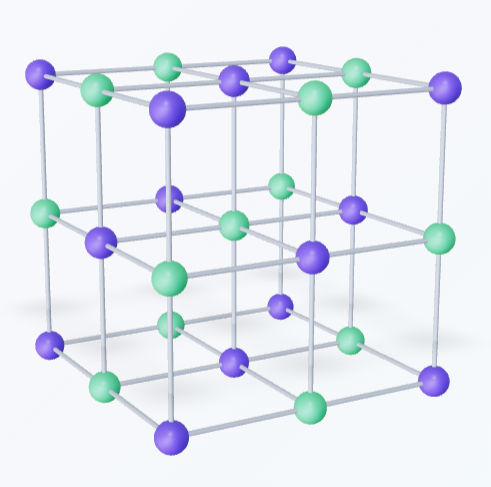
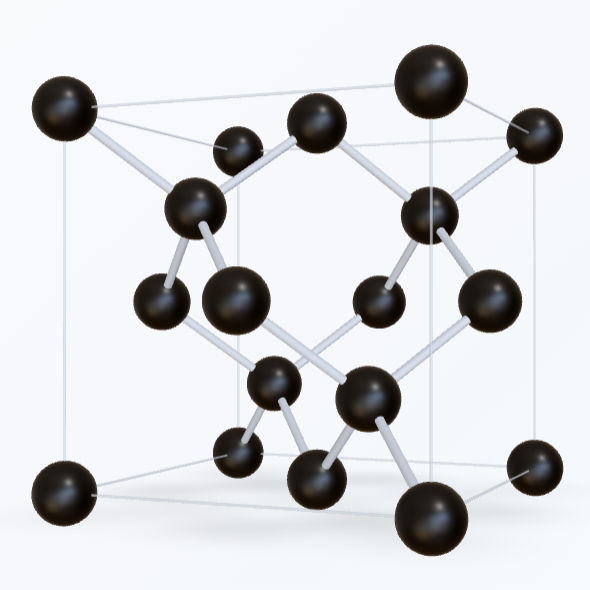
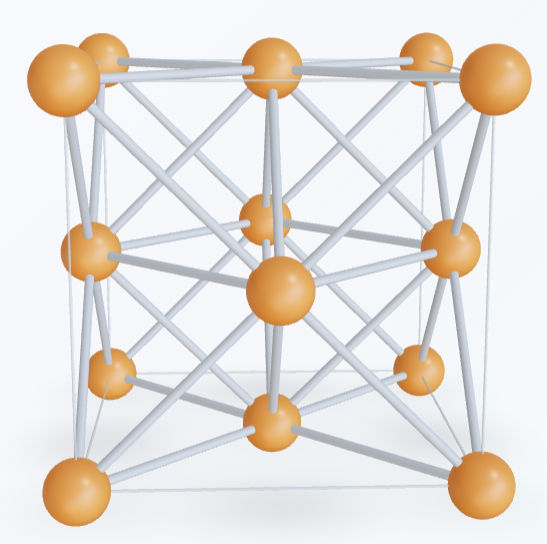
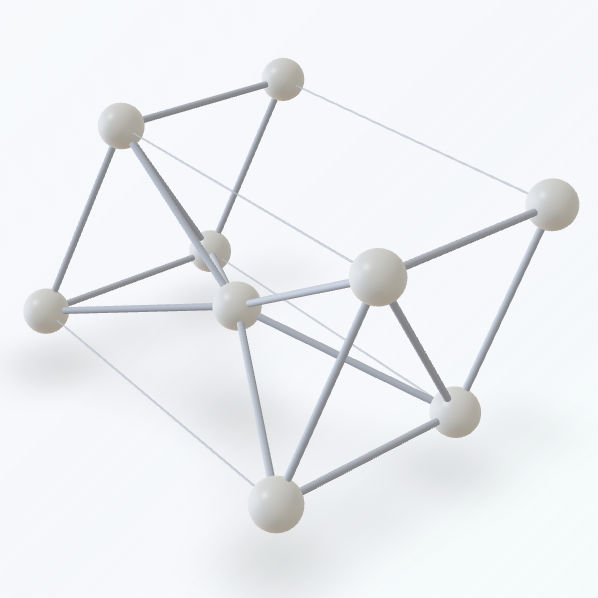
From simple elements to complex ionic compounds — explore the materials students and researchers ask about most.
Meet Crystle
Wordle for crystallography. Identify today's crystal structure in 6 tries — using a 3D viewer and progressive hints. New puzzle every day at midnight UTC.
- ✓A fresh structure to guess every day
- ✓3D viewer rotates as you puzzle it out
- ✓Click any atom to see its coordination shell
- ✓Build a streak. Share your result.
Frequently Asked
Crystallography, answered
Quick answers to the questions students and researchers most often search for.
What is a Bravais lattice?
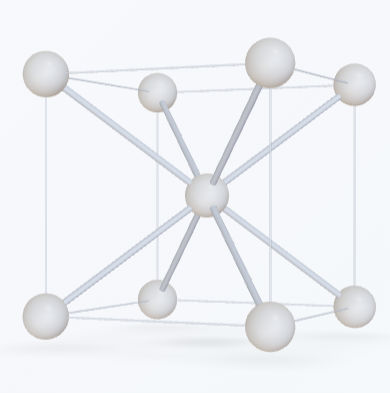
A Bravais lattice is one of 14 distinct three-dimensional lattices that describe every possible periodic arrangement of points in a crystal. They group into 7 crystal systems — cubic, tetragonal, orthorhombic, hexagonal, trigonal (rhombohedral), monoclinic, and triclinic — and form the geometric foundation of crystallography.
What's the difference between BCC and FCC structures?
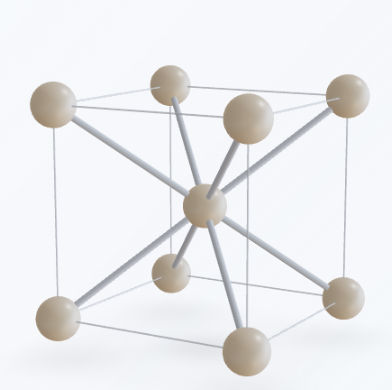
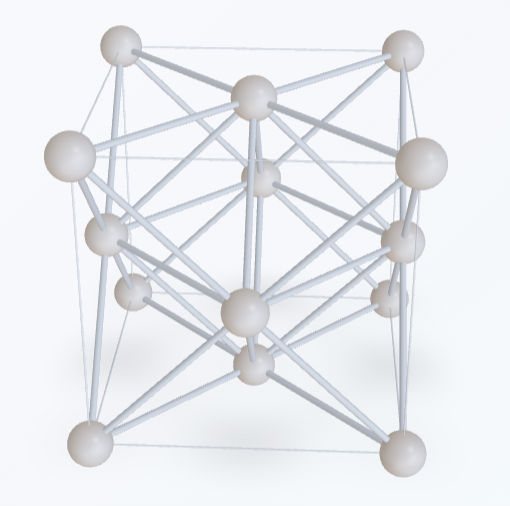
Body-Centered Cubic (BCC) places one atom at each cube corner plus one at the body centre, giving 2 atoms per unit cell, a coordination number of 8, and 68% packing efficiency. Face-Centered Cubic (FCC) has atoms at each corner and on every face, giving 4 atoms per unit cell, a coordination number of 12, and 74% packing efficiency — the densest cubic packing possible.
What is Atomic Packing Factor (APF)?
APF is the fraction of a unit cell's volume occupied by atoms, modelled as hard spheres. Common values: SC = 52%, BCC = 68%, FCC = HCP = 74%. Higher APF means a denser, more efficiently packed structure. You can compute APF interactively in our APF calculator.
What are Miller indices (h k l)?
Miller indices are a set of three integers (h k l) that uniquely identify a plane or direction within a crystal lattice. They are the reciprocals of the plane's intercepts with the crystal axes, reduced to lowest integer terms. Miller indices are essential for X-ray diffraction analysis, slip-system identification, and surface science.
What is a Brillouin zone?
A Brillouin zone is the primitive cell of the reciprocal lattice — the set of points in k-space closest to a given reciprocal-lattice point. The first Brillouin zone is fundamental in solid-state physics for describing electron band structure, phonon dispersion, and the behaviour of waves inside a periodic crystal.
How does Bragg's Law work?
Bragg's Law (nλ = 2d sin θ) relates the wavelength λ of incident X-rays, the interplanar spacing d, and the diffraction angle θ that produces constructive interference. It is the cornerstone of X-ray diffraction (XRD), letting researchers determine crystal structures from diffraction patterns.
Is SolidState3D free to use?
Yes. All 14 Bravais lattices, the materials database, and the calculators (Bragg's Law, Miller indices, APF, band gap, symmetry) are free in your browser — no install, no account required. Optional sign-in lets you save favourites and use Crystal AI.
Do I need to install anything?
No. SolidState3D runs entirely in the browser using WebGL and Three.js. It works on any modern desktop, tablet, or phone — no downloads, plugins, or specialist software required.
Ready to see structures clearly?
Join students and researchers visualizing complex materials without downloading heavy localized software.